The Little Mammy: When a Child Becomes the Carer

Growing up as one of eight children, with an absent mother and an alcoholic and often violent father, meant that childhood didn't always look the way it should have.
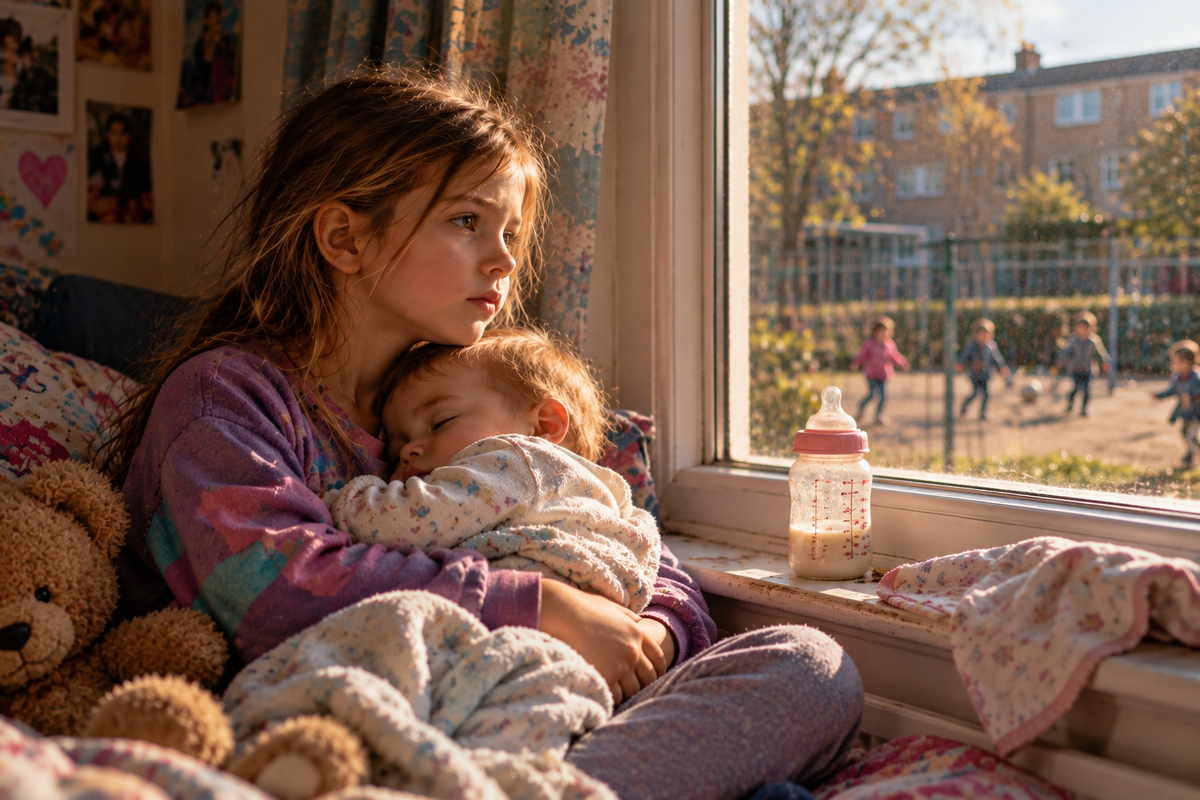
Instead of making friends, learning spellings for homework and playing like the other kids around the neighbourhood, I was folding laundry, preparing formula bottles, changing nappies and babysitting my younger siblings.
Living in a dysfunctional family where no one really knows what's going to happen next can be emotional torture for a young child. And it was for me.
I became a mammy at age seven and I was praised for it.
While writing my memoir, I returned to a memory from my time living in a women's refuge in Rathmines, Dublin. Looking back at it now, I can see how something as ordinary as tidying a bedroom helped shape the role I would come to take on within my family.
At the time, though, I was just a child who wanted to go outside and play.
From My Memoir In Progress
The following scene is adapted from the memoir I am currently writing.
“April, after dinner you need to go and tidy our room in time for room inspections,” Mammy said.
Stephen smirked at my annoyance.
“What? Why do I have to do it? I want to go outside,” I replied.
“Do it or you’ll be in trouble.”
I let out a big sigh, knowing there was no point in arguing when I would still end up doing it. Stephen continued to smile at how irritated I was.
“You too,” Mammy said, gesturing towards Stephen.
“Mine’s already clean,” he said proudly, finishing his last bite.
After dinner, I walked towards our room slowly, trying to delay the inevitable. I opened the door to reveal a room that was upside down. The bins were overflowing, the beds unmade, and clothes were scattered across the floor, mixed with random shoes and toys.
My bed was the only one made and my shelf was the only place where everything sat neatly arranged.
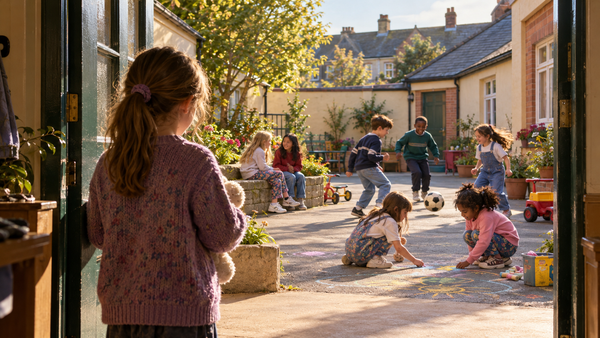
Throwing my head back and releasing yet another sigh of frustration, I got to work. I turned on MTV to drown out the noise of all the other children playing in the courtyard and began sorting the clean clothes from the dirty.
There wasn’t much to sort through. Most of the clothes were stained with food anyway.
By the end of a few songs, the room was tidy. Shoes were lined up according to each child, clean clothes were folded on the shelves and dirty ones gathered in the corner for Mammy to wash. The toys and books were back in their rightful places, with teddy bears sitting on neatly made beds.
I’d even found a few extra soothers for Lucy and Holly.
The sound of jingling keys echoed down the hallway.
It was Joan.
“Room inspections, everyone,” she announced.
I knew she would start at Room One, so I still had time to do my finishing touches and get rid of the last bit of rubbish.
Soon enough, she appeared in the doorway.
“Well! Look at this!” she said, stepping into the room and glancing around.
I stood quietly awaiting the verdict while she looked under the beds for hidden clutter.
How did I forget to do under the beds!
Jean straightened up and smiled at me.
“Great job! Did you do all this yourself?”
“Yes,” I said proudly.
Jean’s smile faltered a little. Her eyes moved slowly around the room.
Eight neatly made beds.
Eight piles of folded clothes.
Eight pairs of shoes lined up against the wall.
“All of it?” she asked.
I nodded.
She looked down at me for a moment, then over at the bag of dirty laundry waiting for Mammy.
Something flickered across her face. Surprise, maybe. Or pity.
“Where’s your mammy?” she asked.
“In the canteen.”
Joan nodded slowly.
“I see.”
She wrote something down on her clipboard.
Then she opened her mouth as if she wanted to ask another question, but after a moment she simply nodded.
“Well,” she said, forcing a smile back onto her face. “It’s the tidiest room in the house.”
I beamed with pride.
As I lay on a bed enjoying a new book, Mammy came in to change Lucy’s nappy.
She looked around the room while placing Lucy on the bed.
“Looks clean! Good girl!” she said while searching for a nappy on Lucia’s shelf.
I smiled to myself, after she left.
If keeping everyone happy was as simple as cleaning a room, then I would keep doing it.
And I did.
The days rolled on as normal. We played in the courtyard after breakfast or walked into Rathmines with Mammy, occasionally stopping at our favourite playground in Belgrave Square.
We had settled into our new life well and, in some ways, had begun to put down roots. Mammy would send me to the shops whenever she needed something, and every now and then I was allowed to buy myself a large Müller yoghurt as a reward.
Back at the refuge, I’d sit in the canteen with a book, savouring every spoonful of the smooth, sweet yoghurt. Those small treats felt like luxuries.
Meanwhile, the room continued to fall apart each day, and each evening I put it back together again.
At first, I enjoyed it. I liked the praise and the approving smiles from the adults. But before long, I found myself wanting everything in its exact place. Beds had to be made properly. Shoes had to be lined up correctly. Toys belonged where I’d decided they belonged.
The pressure of recreating that same positive reaction became exhausting.
Over time, tidying the room became as automatic as brushing my teeth. I no longer thought about whether it was my job.
I just did it.
The praise faded away, but the expectation remained.
When Praise Becomes Expectation
Looking back now, I understand why the praise mattered so much.
In a childhood where so much felt beyond my control, being useful gave me a sense of purpose. I could make a bed, quieten my younger brothers and sisters, prepare bottles of formula, feed my baby sister and put her to bed. I could find the missing soother, make the room look right, even when very little else in our lives was.
And people noticed me doing it.
Being told I was "a little mammy" sounded like a compliment at a time when compliments or praise was a rare thing to come across. But, I didn't hear the warning hidden inside those words.
What I heard was: You're helpful. You're needed.
So I kept doing it and eventually, I didn't need to be asked.
There is, of course, nothing wrong with children helping at home. Age-appropriate responsibilities can teach children independence, kindness and what it means to contribute to family life.
Think, for example, of a small child coming home from school clutching a drawing they've made for Mammy or Daddy. They proudly hand it over and wait for a reaction. Mammy smiles, Daddy tells them how beautiful it is, and perhaps it earns a special place on the fridge.
The child beams with pride so they draw another one.
It's a simple example, but it illustrates something most of us will recognise about childhood. The reactions of the adults we love matter hugely to us. We notice the things that earn a smile, encouragement or praise. I certainly did, but, for me, it wasn't a drawing. It was being useful.
Research into parentification makes an important distinction between children contributing to family life and children taking on developmentally inappropriate adult or parental responsibilities.
But there is a difference between teaching a child responsibility and making them responsible for more than they are capable of coping with. A big difference.
Looking back at the scene above as an adult, I can see that a line was crossed that should never have been crossed. It wasn't that I was occasionally helping Mammy with my younger brothers and sisters. It was the fact that I was changing nappies, preparing bottles, feeding children, babysitting and cleaning up after a family of eight.
That's too much for any child.
The complicated part is that I was good at it. And because I was capable of doing those things, it became very easy for the adults around me to forget that I shouldn't have had to.
That is something I think about when we describe children as "mature for their age", "little mammies", "little men of the house", "so independent" or "wise beyond their years".
These things can be true but sometimes, and particularly in my situation, we are looking at a child who has become very good at coping.
Perhaps instead of just praising a child for how much responsibility they can carry, we should also be looking and asking why they are carrying so much.
Who looks after the child who is always looking after everyone else?
For me, becoming Mammy at seven didn't end when I stopped making bottles or changing nappies. It taught me something much harder to unlearn in later years when we were all taken into care: that being needed feels like being loved. That keeping everyone else happy makes me feel safe. That my own needs could wait because somebody else's always seemed more important.
Those lessons can follow a child long after childhood has ended.
I still believe there was something beautiful in the little girl who wanted to care for her brothers and sisters and I wouldn't ever want to take that away from her. She loved them and wanted to help them, and sometimes she genuinely enjoyed doing it. But she just shouldn't have been responsible for them.
She deserved unconditional love and praise but she also deserved permission to put the bottle down, leave the beds unmade, run outside into the courtyard and play.
She deserved to make the mess sometimes without the guilt and burden of tidying it up afterward.
She deserved to be seven.
Join the Conversation
Have you ever been described as “mature for your age”, “a little mammy”, “the man of the house” or felt responsible for other people while you were still a child?
If this story resonates with you, you're welcome to share your thoughts or experiences in the comments below.
Stories Within is a space for telling the stories we carry with us, reflecting on the experiences that shaped us and giving a voice to things that are sometimes difficult to put into words.
If you'd like to continue reading, you can subscribe to receive new stories and reflections as they are published.
Read Next
The Story Behind Stories Within
Why I began writing about the experiences we carry from childhood, the stories that stay with us, and why I believe those stories deserve to be told.
→ Read The Story Behind Stories Within
Sources & Further Reading
Dariotis, J. K., Chen, F. R., Park, Y. R., Nowak, M. K., French, K. M., & Codamon, A. M. (2023). Parentification Vulnerability, Reactivity, Resilience, and Thriving: A Mixed Methods Systematic Literature Review. International Journal of Environmental Research and Public Health, 20(13), 6197.
This systematic review brings together research on parentification and explores the complexities of children and young people taking on developmentally inappropriate adult or parental roles and responsibilities.
→ Read the research:
Parentification Vulnerability, Reactivity, Resilience, and Thriving